
Local Fiscal and Demographic Effects of Renewable Energy Benefit-sharing in Sinan-gun: Evidence using the Synthetic Control Method

© 2026 by the New & Renewable Energy
This is an Open Access article distributed under the terms of the Creative Commons Attribution Non-Commercial License (http://creativecommons.org/licenses/by-nc/4.0) which permits unrestricted non-commercial use, distribution, and reproduction in any medium, provided the original work is properly cited.
Abstract
The unequal distribution of renewable energy (RE) revenues, which primarily benefits external developers while imposing environmental costs on local communities, remains a significant barrier to community acceptance during the energy transition. Sinan-gun, Jeollanam-do, addressed this issue through a local ordinance that established a benefit-sharing scheme (the “Sunshine Pension”) that distributes RE development revenues directly to residents. This study applies the Synthetic Control Method (SCM) to estimate the causal effects of this policy on a panel of 27 rural municipalities from 2005 to 2024. The outcome variables are local tax revenue and net migration rate. Local tax revenue increased by approximately 132% relative to the synthetic control following the facility’s expansion. A tax decomposition further demonstrates that this increase extends beyond facility-linked taxes to activity-based taxes, such as local income and resident taxes, which expanded at a significantly faster rate than in regions with comparable RE capacity but no benefit-sharing ordinances. A potential transition from net outflow to net inflow is observed between 2022 and 2023, although the statistical significance remains limited. These results suggest that ordinance-based benefit sharing may strengthen local fiscal capacity and support population retention in rural areas, pending further validation.
Keywords:
Energy transition, Renewable energy, Local economy, Benefit-sharing, Synthetic control method, Sunshine pension키워드:
에너지전환, 재생에너지, 지역경제, 개발이익공유, 통제집단합성법, 햇빛연금1. Introduction
The Korean government set its 2035 NDC at a 53–61% reduction from 2018 net emissions (742.3 MtCO2eq), considering the urgency of the climate crisis, IPCC recommendations, and the mitigation burden on future generations.[1] Achieving even the lower bound of 53% requires a renewable energy (RE) share exceeding 30% in the national energy mix. Given the current share (10.6%) and the pace of deployment, rapid expansion of RE infrastructure is a high-priority policy concern. Although RE is generally regarded as a generation source with negligible environmental externalities compared to conventional fossil fuels, constructing and operating facilities to replace existing power plants imposes costs borne by local communities, mainly in rural areas,[2,3] while benefits are dispersed among urban regions, developers, and landowners. This spatial asymmetry between costs and benefits creates a recurring divergence between sociopolitical acceptance of the energy transition at the national level and community acceptance at the local level, a phenomenon referred to as the “social gap.”[4~7] In Korea, increasing complaints and resistance related to RE facility siting have led to stricter siting regulations and frequent project delays.[8,9] The Act on Support for Communities Adjacent to Power Plants (Act No. 17528), however, remains focused on offsetting the environmental costs of conventional generation sources such as thermal and nuclear power, leaving it unclear whether the current institutional framework allocates sufficient benefits to compensate for the social costs experienced by local residents.[10~12]
Such social conflicts associated with RE projects are not unique to South Korea. Countries that began the energy transition earlier have restructured land-use planning to prevent siting conflicts and developed institutional arrangements to enhance procedural and distributive justice. Institutional approaches have included increasing community participation in the planning and operation of generation facilities to secure procedural justice[13,14] and establishing benefit-sharing schemes for generation revenues to achieve distributive justice.[15] In Korea, community RE projects were first introduced in 2017 in response to these trends, expanding to 117 projects by the end of 2021, with debt-based (80 projects) and equity-based (33 projects) participation as the dominant models.[16] However, existing benefit-sharing and community participation schemes have often failed to ensure transparency and fairness in revenue distribution or to generate local economic growth. These schemes have been criticized for allowing a subset of residents to receive investment returns without genuine financial commitment, falling short of improving community acceptance or fostering equitable local development.[17]
For instance, Denmark and Germany have institutionalized distributive justice through cooperative wind energy projects and citizen-owned power plants.[18,19] Similarly, Sinan-gun in Jeollanam-do, Korea, pioneered distributive justice by establishing the Sunshine Pension. Most community RE projects have typically relied on lease payments and subsidies negotiated with individual developers, limiting benefits to nearby villages or cooperative investors. In contrast, Sinan codified revenue-sharing ratios through local ordinance, established benefit-sharing as a precondition at the project permitting stage, and extended eligibility to all registered residents. Sinan's scheme defines natural resources, including sunlight and wind, as local commons and institutionalizes a commons dividend model that distributes revenues universally to all registered residents.[20,21]
Dividends were first distributed to Sinan residents in April 2021 as local currency (local gift certificates).[22] Sinan's population had declined continuously since 2014 but began to increase in 2023, drawing attention to a possible link between benefit-sharing and demographic trends.[17,23] However, whether these changes are attributable to the Sunshine Pension or to other socioeconomic factors has not been empirically established. This empirical gap is largely due to methodological constraints in policy evaluation. Specifically, Sinan-gun is the only municipality in Korea to have adopted such a scheme. Accordingly, conventional approaches such as difference-in-differences (DID) or panel regression yield unstable statistical inference with a single treated unit and risk arbitrary selection of comparison groups.[24,25] The treated region's distinctive characteristics, including its island geography, high concentration of RE facilities, and primary sector-dependent economy, further increase the likelihood that naïve comparisons introduce selection bias.[25]
Hence, this study employs the synthetic control method (SCM), a quasi-experimental approach, to quantitatively evaluate the effects of Sinan's benefit-sharing scheme on the local economy. The remainder of the paper is organized as follows. Section 2 reviews the literature on community acceptance of RE development, its regional impacts, and policy evaluation studies using SCM. Section 3 describes the analytical framework and procedures. Section 4 presents the empirical results. Section 5 concludes with a discussion of findings and policy implications.
2. Literature review
2.1 Economic effects of renewable energy (RE) development
Research on the local economic effects of RE development has focused primarily on employment, tax revenue, and property values. Pedden[26] showed that RE investment in rural areas with limited alternative industrial bases can contribute to local economies through job creation, income growth, increased tax revenue, and may also stimulate new industries. Empirical studies on the employment and tax revenue effects of wind energy projects consistently report that the construction and installation phase generate a short-term surge in local construction employment and associated tax revenue, while the transition to the operational phase sharply reduces direct employment, diminishing sustained economic stimulus.[27~29] Slattery et al.[29] noted that the magnitude and distribution of these effects depend critically on the extent to which host communities can participate directly in the construction, operation, and ownership of projects, suggesting that the capital-intensive nature of RE development limits the transfer of post-commissioning value-added to local labor markets. Similar patterns are observed in European cases. Lehr et al.[30] highlighted that while Germany's RE support policies may have positive effects on national employment, a trade-off exists through reduced competitiveness of traditional manufacturing due to rising energy prices.
Low community acceptance of RE facilities is partly due to the unequal distribution of costs resulting from declines in property values. The impact of RE facility siting on nearby property values has been studied mainly using hedonic price models. For wind energy, a distance decay effect – where property values decrease near turbines and the effect diminishes rapidly with distance – has been consistently documented.[31~34] Empirical evidence on solar energy facilities is more limited, but significant negative effects on property values near utility-scale solar installations have been reported, consistent with findings for wind energy.[35,36] Gaur and Lang[37] found these effects are concentrated at sites converted from agricultural and forested land. In Korea, empirical analysis of how RE facility siting affects surrounding property values remains insufficient, making it difficult to assess the magnitude of economic externalities imposed on host communities as deployment expands.
2.2 Procedural and distributive justice and community acceptance
The widely held intuition that greater community participation enhances acceptance is supported by various studies, yet systematic comparisons of previous studies reveal considerable complexity in the causal pathways. Baxter et al.[38] argued that acceptance cannot be adequately explained by decision-making processes and cost-benefit outcomes alone; the scale of investment, ownership, and local context operate together. Even identical benefit-sharing arrangements may produce varied acceptance outcomes depending on who holds decision-making authority, at what level benefits accrue, and how institutional design interacts with local conditions such as industrial structure and demographic characteristics. This complexity is also evident in the relationship between the two dimensions of justice. Kluskens et al.[39] showed that specific participation mechanisms may not satisfy all elements of procedural justice and that the extent to which distributive justice is achieved varies with the type and combination of benefit distribution mechanisms. This suggests that while cash dividends can serve as a powerful distributive instrument, they are unlikely to substitute for procedural justice; durable acceptance is more likely when participation design, information sharing, and enforcement transparency are combined.
Ownership structures such as community ownership, shared ownership, and cooperatives are important institutional variables that shape acceptance and perceptions of justice. Hogan et al.[40] found that communities with some form of ownership or shared ownership of generation facilities had more favorable attitudes toward projects, stronger perceptions of procedural and distributive justice, and lower risk perceptions compared to commercially owned projects; cooperative models achieved acceptance levels similar to full community ownership. Walker et al. [41] showed that specifying concrete community benefits positively influences acceptance, but this effect is reduced when benefits are framed negatively as bribery or as financial compensation limited to developers and a small number of local residents. This suggests that benefit-sharing within an institutional framework, rather than through ad hoc negotiation or developer discretion, is more likely to be perceived as a mandated entitlement rather than a discretionary concession. The codification of distribution principles through local ordinance in Sinan may have served as such a design element.
2.3 Limitations in current literature
Discussions of benefit-sharing policies to address the unequal distribution of costs and benefits associated with RE projects have primarily focused on institutional design, surveying community perceptions, or measuring the financial compensation needed to offset facility siting costs. However, studies evaluating the causal effects of benefit-sharing policies on local economies remain limited. Recent research has begun to assess the causal effects of RE facility installation on local economies using quasi-experimental methods,[42,43] but these studies focus on indirect transmission mechanisms such as tax revenue expansion and construction-phase employment, and do not isolate the specific effects of benefit-sharing schemes that distribute generation revenues directly to residents.
Regarding the local economic effects of universal cash dividends similar to Sinan's Sunshine Pension, an empirical literature exists on Alaska's Permanent Fund Dividend (PFD). Jones and Marinescu[44] used SCM to show that the PFD had no significant effect on aggregate employment but produced demand-side effects in the non-tradable sector, suggesting a transmission mechanism in which local cash inflows stimulate regional service industries through increased local consumption. The effects of direct dividends are more pronounced in distributional and poverty outcomes than in aggregate growth. For instance, Berman[45] reported that the PFD significantly reduces poverty, with larger effects among vulnerable populations. However, these findings are based on a state-level resource dividend context; the local economic effects of a scheme that distributes RE revenues directly to residents at the rural local unit level have not been examined at the rural municipality level.
This study addresses this empirical gap by estimating the effects of Sinan's Sunshine Pension on local economic indicators using SCM. The contribution is twofold: it evaluates the effects of RE benefit-sharing policy in terms of observable economic outcomes beyond institutional design frameworks or acceptance perceptions, and it extends the empirical literature on universal dividends to a new context – RE revenue distribution at the rural local municipality level.
3. Methodology
3.1 Synthetic control method (SCM)
SCM is a data-driven comparative case study method that estimates treatment effects by constructing a counterfactual outcome for a single treated unit affected by a specific policy or event, representing the outcome that would have been observed without the intervention[24,46]. The method computes a weighted average of untreated units in the donor pool that best reproduces the treated unit's outcome trajectory and predictors during the pre-intervention period, thereby forming a synthetic control. Furthermore, SCM accommodates a single treated unit and mitigates the influence of unobserved factors by directly reproducing the pre-intervention outcome trajectory.[25]
Suppose that among J + 1 units, one unit (j = 1) is exposed to the intervention after period T0 within a total of T periods, while the remaining J units in the donor pool remain unexposed. The treatment effect can be expressed as Eq. (1)
| (1) |
where α1t denotes the effect of the intervention on the treated unit at time t, is the observed outcome for the treated unit, and is the counterfactual outcome in the absence of the intervention. Since the latter is not directly observable, SCM estimates it as a weighted average of untreated units in the donor pool as expressed in Eq. (2).[25]
| (2) |
SCM finds W* that minimizes the following objective function with respect to the predictor vector X1 for the treated unit and the matrix X0 for the donor pool (see Eq. (3)):
| (3) |
where V is a positive semi-definite diagonal matrix that reflects the relative importance of each predictor, determined to minimize the mean squared prediction error (MSPE) for the outcome variable over the pre-intervention period.[24]
Because parametric standard errors are not readily available for SCM, the statistical significance of the estimated effect is assessed through in-space placebo tests.[24,47] The SCM procedure is iterated for each unit in the donor pool to obtain placebo effects. Significance is evaluated by examining whether the ratio of post-intervention to pre-intervention root mean squared prediction error (RMSPE) for the treated unit is in an extreme position within the placebo distribution.[24]
Let gᵢₜ denote the gap for placebo unit i (Eq. (4)):
| (4) |
Here, the pre-intervention and post-intervention RMSPE are defined as:
| (5) |
By using these two RMSPE values, Rⱼ can be calculated as the post-to-pre RMSPE ratio. The significance of the estimated effect is assessed by counting the number of units in the donor pool for which Rⱼ ≥ R₁.
3.2 Data and variable description
The donor pool was selected to minimize extrapolation bias by considering structural similarities to Sinan-gun. The selection criteria are as follows. First, municipality-level units with pre-intervention characteristics similar to Sinan, including population size, share of elderly population, and fiscal autonomy ratio, were prioritized. Selected coastal municipality units (e.g., Tongyeong-si, Taean-gun) were included to account for geographic similarities with coastal and island regions. Second, given the distinctive characteristics of Sinan-gun, which comprises 1,025 islands, the donor pool was narrowed to units sharing geographic and industrial similarities, specifically maritime and island regions or units with primary sector-dependent economies. Counties within Jeollanam-do, the same provincial jurisdiction as Sinan, constitute the largest share of the donor pool due to their similarity in fiscal structure, demographic composition, and accessibility from major urban centers. Finally, units potentially subject to treatment spillovers were excluded. The list of donor pool units is presented in Table 1.

Donor pool
The dataset is a panel of annual observations for 27 units, including Sinan, from 2005 to 2024. The sample period for the local tax revenue model is divided into pre-intervention (2005-2019) and post-intervention (2020-2024), while the net migration rate model covers pre-intervention (2005-2020) and post-intervention (2021-2024). The data were collected from Statistics Korea (KOSIS), the Ministry of the Interior and Safety's Local Finance 365 (LOFIN 365), Gross Regional Domestic Product (GRDP), and other administrative statistics. GRDP figures are subject to a two-year reporting lag, resulting in missing observations for 2023-2024; however, these account for less than 10% of total observations, and since weight estimation relies on pre-intervention outcomes and predictors, the impact on the estimates is expected to be minimal.
This study distinguishes two channels of the treatment effect and estimates each independently (see Table 2). The first outcome variable is local tax revenue, which reflects the fiscal channel, namely the expansion of local public finance resulting from the operation of RE facilities. The construction of large-scale solar and wind generation facilities in the region is expected to increase tax receipts, including acquisition tax and property tax. The intervention date is set at 2020, when facility operation reached full scale and is assumed to have produced measurable effects on the local economy.
Outcome and predictor variables
Table 3 presents Sinan’s RE generation from 2019 to 2024.[50] Solar generation nearly tripled from 27,638 toe in 2019 to 93,447 toe in 2021, and total RE generation increased by 441% between 2019 and 2024. The sharp rise in Sinan’s local tax revenue in 2020 (+190% in level terms) aligns with the timing of this transition.
RE generation capacity in Sinan-gun
The second outcome variable, the net migration rate, captures the dividend channel, meaning the residential retention incentive generated by payments to residents. The intervention date for this outcome is set at 2021, when the dividend payments began.
Predictors used to determine synthetic control weights are classified as time-invariant predictors, time-varying predictors, and lagged outcome values. Time-invariant predictors, such as primary sector share and administrative area size, were averaged over the pre-intervention period. Time-varying predictors include gross regional domestic product (GRDP), share of elderly population, and the number of national pension service (NPS) subscribers. Following Abadie et al. (2010), lagged values of the outcome variable were also included as predictors. The time points for time-varying predictors and lagged outcomes differ across models, reflecting both differences in intervention dates and the temporal properties of each outcome variable.
Model 1, with an intervention date of 2020 and 15 pre-intervention years, measures predictors at approximately five-year intervals (2005, 2010, 2015, 2019) to capture medium-term changes in economic and demographic structure. Lagged outcome values are spaced at the same intervals, as local tax revenue follows a relatively smooth trend for which evenly spaced lags are well suited to tracking the long-run outcome trajectory.[24] Model 2, with an intervention date of 2021, adjusts predictor time points (2012, 2015, 2018, 2020) to capture both medium-term structural change and information immediately preceding the intervention. Lagged outcome values are entered as consecutive annual values from 2016 to 2020 to avoid overfitting to idiosyncratic shocks caused by the high year-to-year volatility of net migration rates. Sinan's net migration rate showed an accelerating outflow pattern between 2016 and 2020; achieving a close fit for this pre-intervention declining trend was considered essential for identifying the treatment effect in the post-intervention period.[47,48]
GRDP controls for overall regional economic performance, and the share of the elderly population controls for demographic structure. NPS subscribers serve as a proxy for the economically active population, reflecting local labor market size. Nested optimization, combining BFGS and Nelder-Mead, was employed.[24] The overlap between the intervention dates and the COVID-19 pandemic raises the possibility of confounding in population movements and local public finance. However, because the synthetic control is exposed to the same exogenous shock, the common shock affects both the treated unit and the synthetic control and is therefore netted out in the estimated gap, allowing identification of the effect of the intervention.
3.3 Identification challenges
Sinan’s benefit-sharing policy was implemented alongside large-scale renewable facility construction. This timing makes it difficult to separate revenue changes attributable to the policy from those automatically generated by expanded siting and construction. Therefore, the SCM estimate should be interpreted as the combined effect of Sinan-specific changes after the intervention rather than the standalone effect of the Sunshine Pension.
To clarify this identification issue, local tax revenue was decomposed into two components. The first consists of taxes directly linked to physical facilities (e.g., property tax and the local resource and facility tax), which tend to rise automatically with siting regardless of benefit-sharing. The second consists of activity-based taxes (e.g., local income tax, resident tax, and automobile tax), which more plausibly reflect changes in local economic activity that could be influenced by cash transfers. If siting alone were the primary driver of fiscal growth, activity-based taxes would be expected to evolve similarly across regions with comparable RE capacity. This decomposition is descriptive rather than causal, but it could provide supporting evidence for the plausibility of a benefit-sharing mechanism.
4. Empirical analysis results
4.1 Construction of synthetic control
Figure 1 shows the trends of the two outcome variables, local tax revenue and net migration rate, for Sinan and the donor pool units. In the upper panel of Fig. 1, Sinan's local tax revenue (log-transformed) shows a gradual upward trend from 2005 to 2019, remaining below the 20th percentile of the donor pool. After utility-scale facility operation began in 2020, tax revenue increased by approximately 190% in level terms, rising from 29.8 billion KRW to 86.3 billion KRW, and has remained at a relatively high level since then. During the pre-intervention period, Sinan's values fall within the convex hull of the donor pool, confirming that the validity of SCM estimation is met.
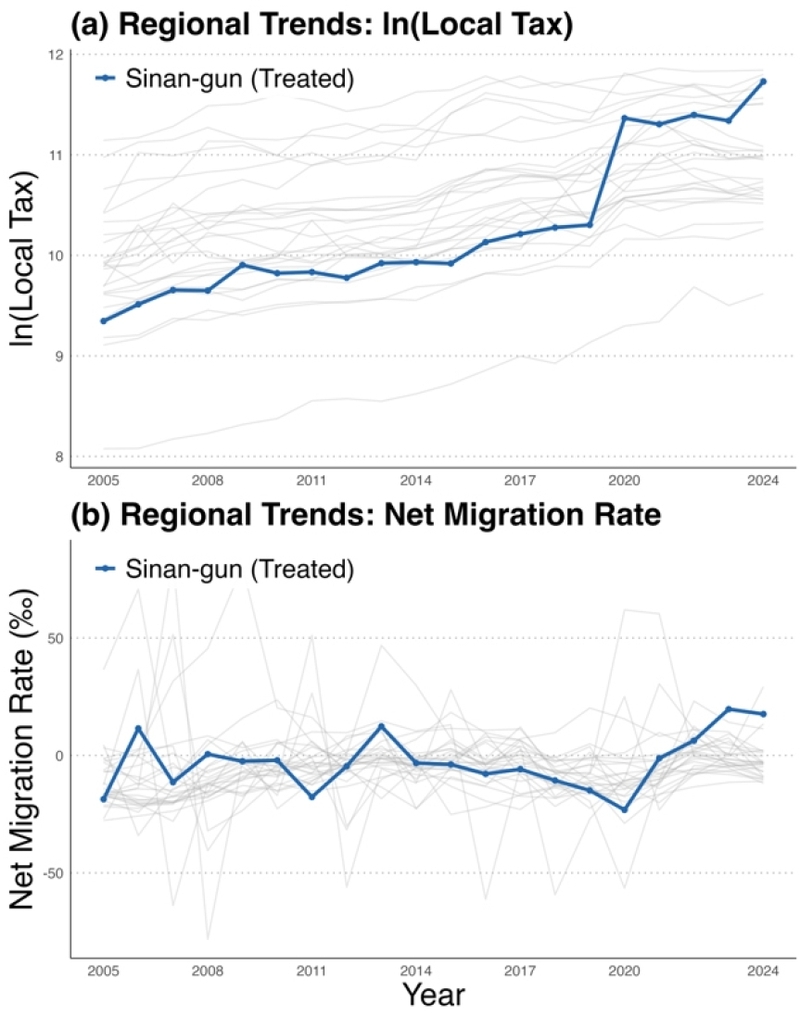
Time-series trends of outcome variables (2005-2024)
Lower panel of Fig. 1 shows that Sinan's net migration rate exhibited sustained outflow before treatment, with an accelerating pattern between 2018 and 2020. This trajectory is broadly consistent with the rural depopulation trend observed across the donor units, though Sinan experienced a considerably larger outflow in 2020. From 2021 onward, a sharp reversal is observed, and by 2023 Sinan stands in clear contrast to most donor units, which continued on a negative trajectory. The net migration rate falls below the donor pool minimum in only one year of 2011.
Table 4 presents the synthetic control weights for Sinan. In Model 1, the synthetic control consists of three units: Jindo-gun (44.0%), Goheung-gun (30.7%), and Jangheung-gun (23.0%), with a small weight for Haenam-gun (2.3%). This weight structure suggests that Sinan's pre-intervention fiscal trajectory closely matches a combination of southwestern coastal rural local units. In Model 2, the synthetic control displays a more dispersed weight structure across 16 donor units. Because migration is influenced by a broader range of factors than local tax revenue, the synthetic control assigns weights to a more diverse set of donors.
Synthetic control weights (top 5)
Tables 5 and 6 compare predictor values for the treated unit (Sinan), the synthetic control, and the donor pool average. In Model 1, the synthetic control closely matches Sinan's predictor values, and lagged outcome values show only minor discrepancies except for 2015.
Predictor balance (Model 1)
Predictor balance (Model 2)
In Model 2, the synthetic control closely tracks the pre-intervention outcome trajectory, indicating that including multiple pre-treatment outcome lags captures the accelerating outflow pattern observed immediately before the intervention. Although balance on period-averaged covariates is weaker than in Model 1, the synthetic control matches GRDP well, suggesting that the optimization placed greater weight on economic scale than on demographic characteristics.
4.2 Model 1: Local tax revenue
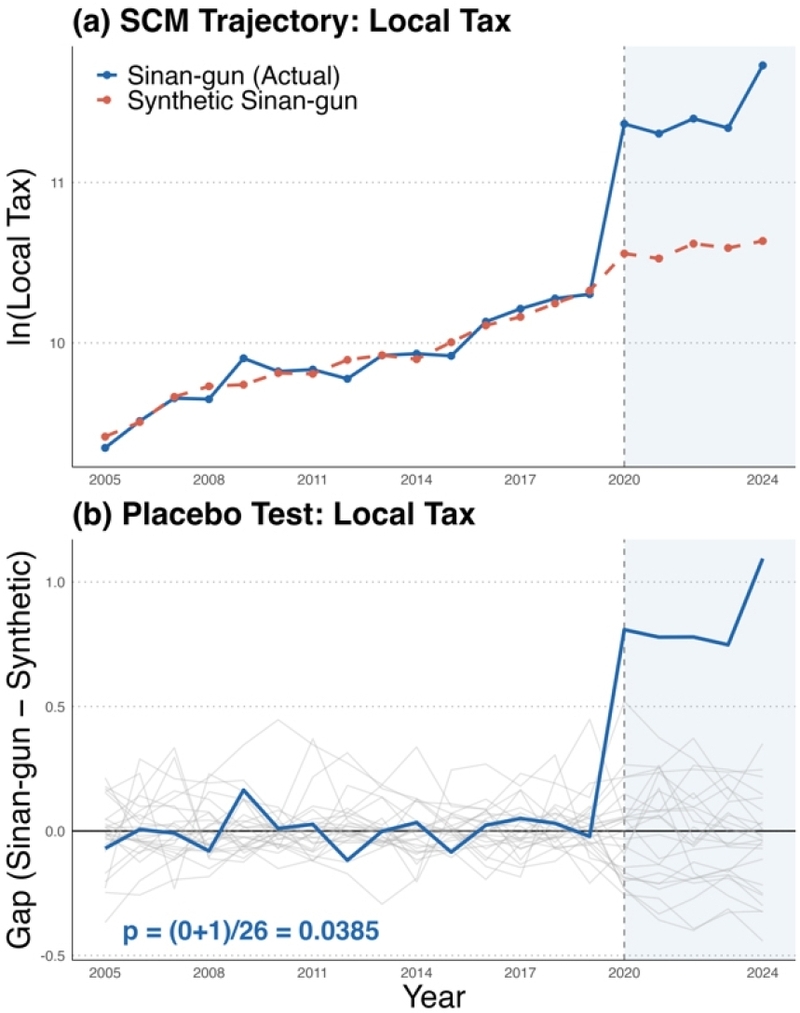
Figure 2 presents the SCM estimation results for local tax revenue. The upper panel of Fig. 2 plots the trajectory of synthetic Sinan (dashed line), constructed using the weights reported in Table 3, against the observed outcome for Sinan (solid line). The two series track closely throughout the pre-intervention period. Sinan's tax revenue began to rise noticeably around 2019, coinciding with the accelerated conversion of abandoned salt farm sites to solar facilities following the decline in sea salt prices in 2017-2018, and the start of utility-scale facility permitting and construction after the enactment of the benefit-sharing ordinance in October 2018. The resulting increase in acquisition and property taxes associated with site purchases and facility construction plausibly explains this timing.[49,50]
Synthetic control estimates (Model 1)
The lower panel of Fig. 2 presents the results of in-space placebo tests. The gap between Sinan and synthetic Sinan (blue line) fluctuates around zero before 2019-2020 and rises sharply from 2020 onward.
Table 7 summarizes the year-by-year estimated effects. During the pre-intervention period (2005-2019), the gap between Sinan and synthetic Sinan fluctuates within a narrow range of about ±0.11 log points, indicating a close pre-intervention fit.
Estimated treatment effects (Model 1)
From 2020 onward, a large and persistent gap appears between the two series. The estimated effect emerges immediately in the first post-intervention year and remains stable through 2021-2023. The average estimated effect is 0.840 log points, corresponding to an approximately 131.5% increase in local tax revenue in level terms. The fiscal effect occurred through relatively immediate transmission mechanisms, including the expansion of the tax base from facility construction and operation.
4.3 Tax revenue decomposition
To assess whether the observed fiscal expansion reflects the mechanical effect of RE siting or also changes associated with the benefit-sharing scheme, this section decomposes Sinan's tax revenue into two components. Facility-linked taxes (Group A), including property tax and local resource and facility tax, increase mechanically with the assessed value and operation of generation facilities. Activity-based taxes (Group B), including local income tax, resident tax, automobile tax, and tobacco consumption tax, are more sensitive to local economic activity, household income, and consumption.
Table 8 presents the decomposition results. Between 2019 and the 2022-2024 average, Sinan's Group A taxes increased by 28.6%. Group B taxes increased by 180.6% over the same period, a magnitude difficult to attribute to siting effects alone. Table 8 also presents Group B growth rates for five comparison regions hosting large-scale RE installations without benefit-sharing policies: Haenam-gun (177,651 toe in 2024), Taean-gun (181,438 toe), Yeongam-gun (159,159 toe), Goheung-gun (152,943 toe), and Buan-gun (70,065 toe). Group B growth in these regions ranges from 37.2% to 109.9%, with Sinan exceeding the maximum by a factor of 1.6.
Tax revenue decomposition
However, activity-driven taxes can also be associated with facility construction and operation, for example, through local income tax on project workers. The decomposition therefore cannot cleanly distinguish dividend-induced demand effects from siting-related employment and business spillovers. The larger Group B growth in Sinan compared to similar high-renewable regions is suggestive evidence of a benefit-sharing channel, but it is not conclusive.
4.4 Model 2: Net migration rate
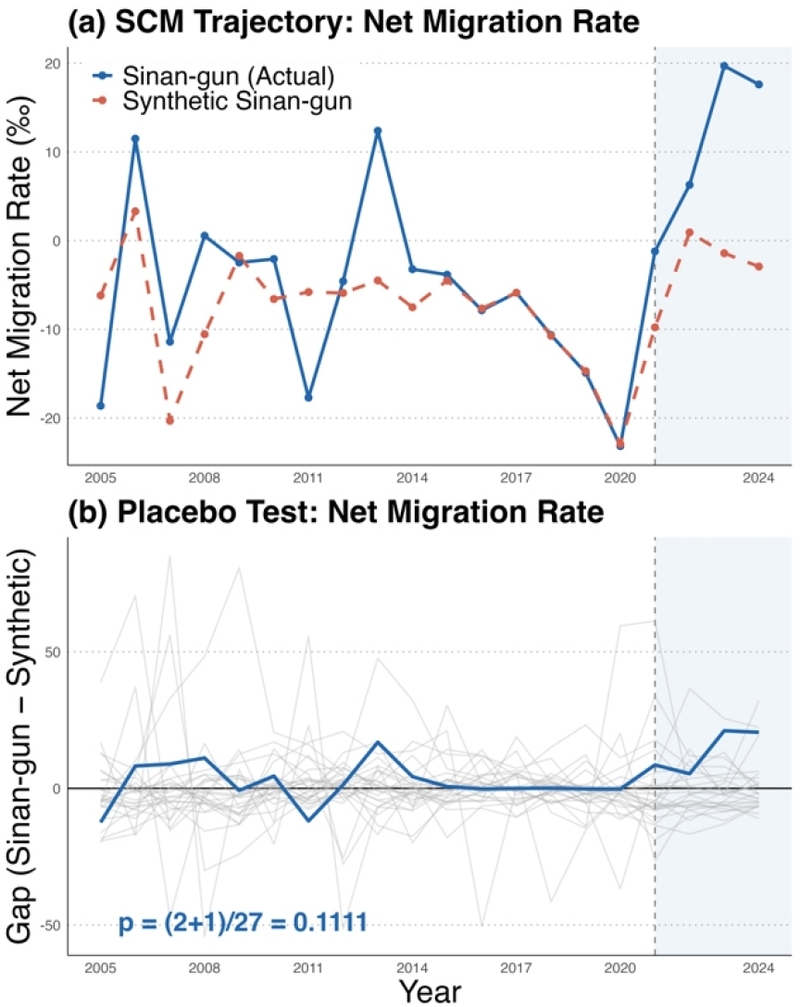
Figure 3 presents the SCM results for Model 2. The estimates exhibit a more complex pattern than the local tax revenue model, with larger deviations that reflect the inherent volatility of population movements in small rural communities. Nonetheless, the synthetic control adequately captures Sinan's pre-intervention net outflow trajectory. The accelerating decline between 2019 and 2020 is likely due to the confounding effect of the COVID-19 pandemic, as discussed earlier.[51,52]
Synthetic control estimate (Model 2)
The limited statistical significance of Model 2 (p = 0.074) requires careful interpretation (see Table 9). Two methodological factors contribute to the weaker inference. First, migration rates show substantially higher pre-intervention variance than fiscal variables, which mechanically compresses the RMSPE ratio even when a genuine treatment effect exists. Because only four post-intervention years are available, furthermore, the observed upward trend is concentrated in 2023-2024, suggesting the population effect may still be developing as residents respond to the policy with a delay. Therefore, these results should be considered preliminary rather than conclusive.
Estimated treatment effects (Model 2)
4.5 Robustness checks
The Leave-One-Out (LOO) test iteratively excludes each high-weight donor unit and re-estimates the synthetic control to assess whether the results are driven by any single unit. In Model 1, the estimated effect remains stable across all exclusions (Fig. 4). Model 2 shows greater sensitivity to individual donor exclusions, reflecting its more dispersed weight structure across 16 units, but the direction of the estimated effect is preserved in all cases.
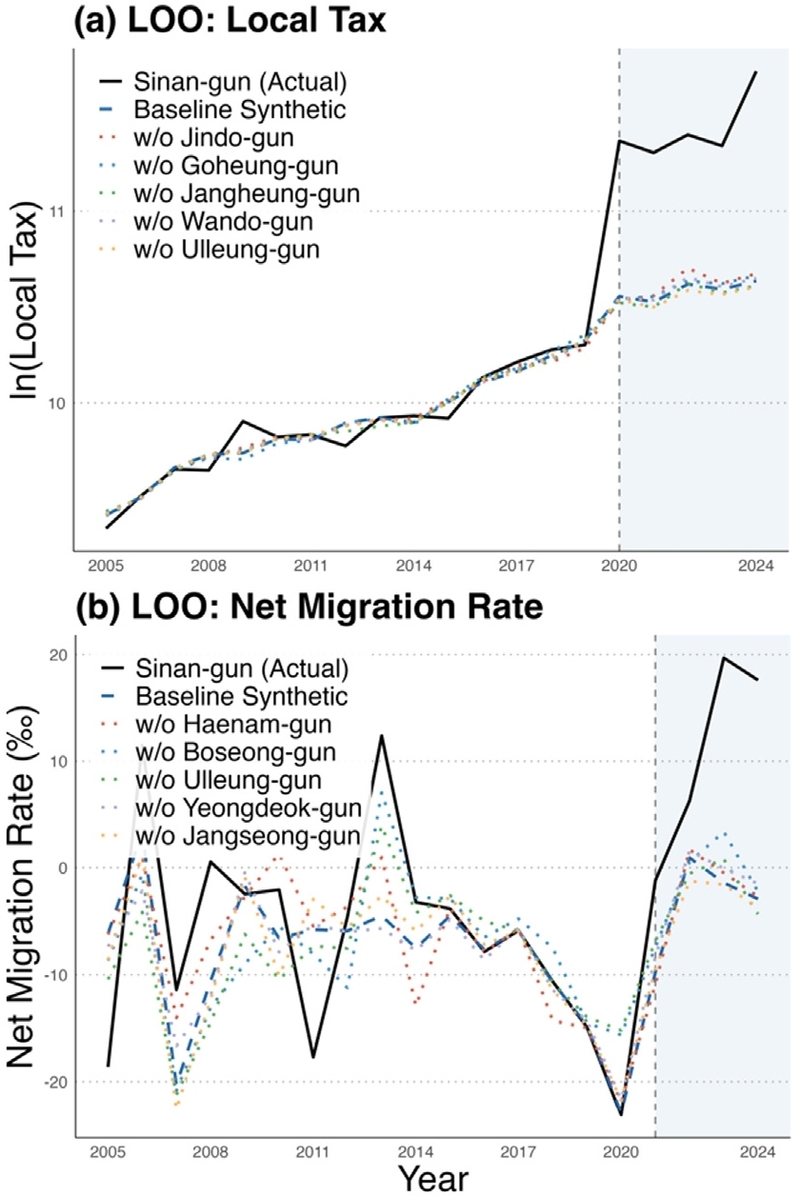
Leave-One-Out (LOO) test results
The in-time placebo test assigns a fictitious intervention date to a pre-intervention period to assess whether the estimated effect reflects pre-existing trends. In Model 1, the RMSPE ratio at the actual intervention date exceeds those at both placebo dates (Fig. 5), confirming that the fiscal effect is specific to the post-2020 period. The 2017 placebo ratio captures a gradual upward trend consistent with facility-related tax receipts emerging around 2018-2019. In Model 2, the 2017 placebo RMSPE ratio slightly exceeds the ratio at the actual intervention date, likely reflecting the sensitivity of net migration rates to exogenous factors such as business cycle fluctuations and policy changes. In contrast, the 2015 placebo ratio falls below the actual ratio. While these results suggest caution in generalizing the population inflow effect based on Model 2 alone, the direction and magnitude of the estimated effect remain consistent across all specifications.
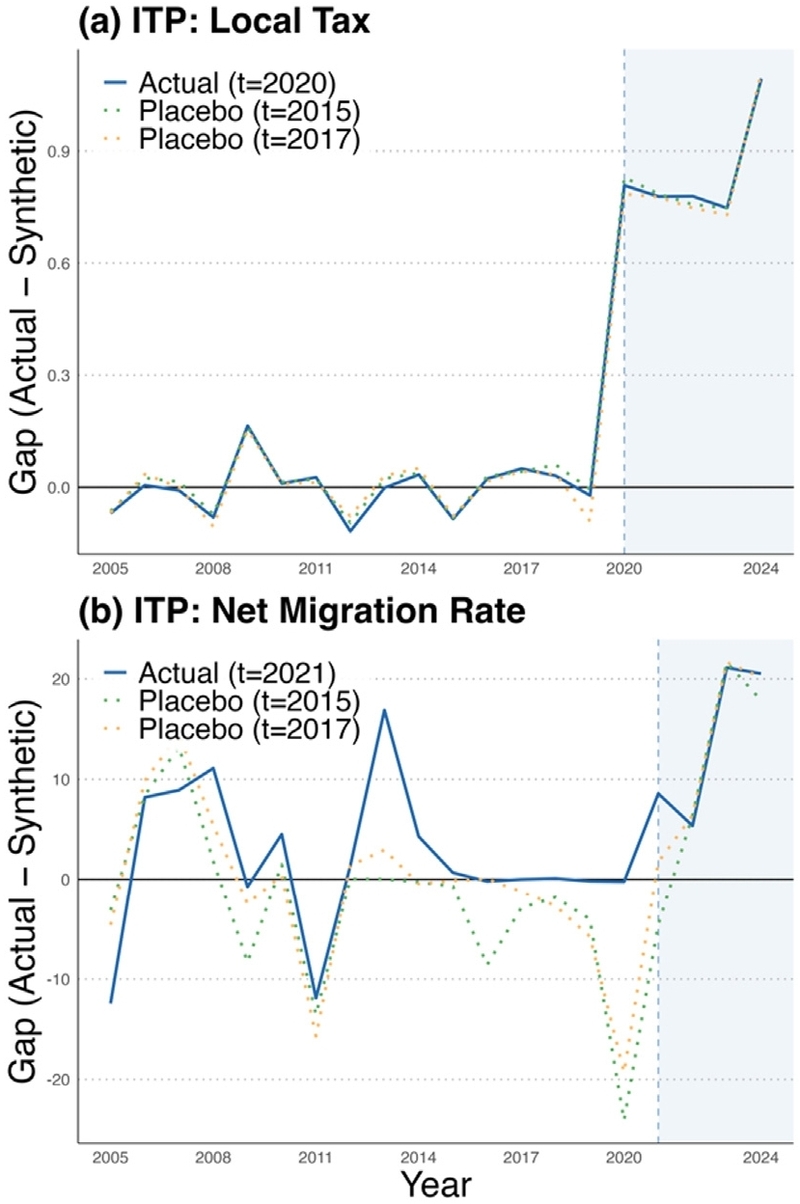
In-time placebo (ITP) test results
The imbalance in primary sector share between Sinan (34.3%) and the synthetic control may also reflect structural differences in RE siting feasibility. Regions with high primary sector shares tend to have extensive low-density land suitable for utility-scale installations, which could confound the estimated policy effect. Both models were therefore re-estimated using a restricted donor pool of regions with a pre-treatment primary sector share of 20% or higher: Haenam-gun (29.3%), Jindo-gun (28.3%), Goheung-gun (27.1%), Hampyeong-gun (25.6%), Boseong-gun (25.3%), Jangheung-gun (24.4%), Buan-gun (22.8%), Gangjin-gun (22.6%), Gurye-gun (21.1%), and Wando-gun (21.1%).
Table 10 compares the estimates across specifications. For Model 1, the average treatment effect and pre-treatment fit remain unchanged, indicating that the baseline synthetic control already relied primarily on structurally similar donors. The permutation p-value increases from 0.039 to 0.091, consistent with reduced statistical power under the smaller donor pool (N = 11) rather than a substantive weakening of the estimated effect. For Model 2, the estimated effect increases modestly and the primary sector share gap narrows. The higher p-value similarly reflects the reduced donor pool size.
Comparison with restricted donor model
5. Conclusions
This study evaluates the effects of Sinan's RE benefit-sharing scheme on the local economy using a quasi-experimental approach. The results provide empirical evidence that the energy transition can strengthen municipal fiscal capacity and potentially promote local economic development through benefit-sharing. The increase in Sinan's local tax revenue, driven by acquisition tax and property tax on facility sites and ancillary structures, registration and license tax from generation project permitting, and resident tax and local income tax from business operations, suggests that rural local units with low fiscal autonomy could strengthen their fiscal base while mitigating the social costs of siting conflicts. A supplementary tax decomposition shows that Sinan's activity-based tax growth (+181%) substantially exceeds that of comparison regions with similar RE capacity but without a benefit-sharing scheme (+37% to +110%). This pattern suggests that the fiscal expansion reflects not only the mechanical effect of facility siting but also demand-side effects of the benefit-sharing policy, consistent with the transmission mechanism documented in the Alaska Permanent Fund literature, where universal cash transfers stimulate local consumption in the nontradable sector. [44]
However, under the current Local Tax Act (Article 142, Paragraph 2, Subparagraph 2), the local resource and facility tax on designated facilities applies only to container terminals, nuclear power, and thermal power generation, excluding solar and wind energy. Since this institutional gap may structurally constrain the tax base of municipalities hosting RE facilities,[53] a redesign of the tax framework to encompass RE generation requires consideration as the energy transition accelerates. Furthermore, the suggestive evidence of a shift to net population inflow, coinciding with increased fiscal returns to the community, is consistent with the hypothesis that benefit-sharing could help improve living conditions and support population retention. However, the statistical significance of Model 2 implies that the estimation results should be regarded as preliminary rather than conclusive. With 89 areas designated as depopulation zones under the Special Act on Local Autonomy, Decentralization, and Balanced Regional Development,[54] the Sinan case provides preliminary evidence that RE benefit-sharing has the potential to operate as a policy instrument for addressing rural depopulation, pending confirmation from longer time-series data.
Several limitations should be noted. Primarily, the overlap between the intervention dates and the COVID-19 pandemic makes it difficult to rule out idiosyncratic shocks specific to island regions. Also, the observed increase in local tax revenue may reflect both the benefit-sharing scheme and the direct tax revenue effect of facility siting, creating a challenge in identifying and separating the two effects. The tax decomposition provides supporting evidence, but it cannot clearly separate dividend-driven demand effects from siting-related fiscal spillovers. Activity-sensitive taxes, such as local income and resident taxes, may increase with construction employment and operational staffing even without benefit-sharing. Cross-regional comparisons are helpful, but they do not eliminate this concern because differences in project scale, rollout timing, and local labor market conditions may also account for part of the gap. Lastly, the post-intervention period is relatively short, making it premature to assess the persistence of long-term effects. Fourth, given Sinan's distinctive geographic conditions and large-scale RE resource potential, external validity may be limited. Future research should revisit the long-term effects as additional post-intervention data become available. Complementary studies using household-level microdata to examine transmission mechanisms, or comparative analyses with similar schemes in other regions such as Jeju, would strengthen and extend this study’s findings.
References
- The United Nations Framework Convention on Climate Change (UNFCCC), 2025, “The Republic of Korea’s 2035 Nationally Determined Contribution (NDC)”, https://unfccc.int/sites/default/files/2025-12/The%20Republic%20of%20Koreas%202035%20NDC.pdf, .
-
Krekel, C., Rechlitz, J., Rode, J., and Zerrahn, A., 2021, “Quantifying the externalities of renewable energy plants using wellbeing data: The case of biogas”, SOEPpapers No. 1116, DIW Berlin, Berlin, https://www.diw.de/documents/publikationen/73/diw_01.c.809799.de/diw_sp1116.pdf, .
[https://doi.org/10.2139/ssrn.3751852]

-
Lee, D.H., 2020, “A study on the acceptance model of offshore wind farm construction and deployment in coastal areas of Korea”, TJOKI, 32(4), 67-87.
[https://doi.org/10.26840/JKI.32.4.67]
-
Bell, D., Gray, T., and Haggett, C., 2005, “The ‘social gap’ in wind farm siting decisions: Explanations and policy responses”, Environ. Polit., 14(4), 460-477.
[https://doi.org/10.1080/09644010500175833]
-
Sovacool, B.K., and Ratan, P.L., 2012, “Conceptualizing the acceptance of wind and solar electricity”, Renew. Sustain. Energy Rev., 16(7), 5268-5279.
[https://doi.org/10.1016/j.rser.2012.04.048]
- Kim, D.J., 2015, “Privatization, commodification, capitalization of winds at Jeju”, ECO, 19(1), 213-256.
-
Lee, H.J., Huh, S.Y., Woo, J., and Lee, C.Y., 2020, “A comparative study on acceptance of public and local residents for renewable energy projects: Focused on solar, wind, and biomass”, Innov. Stud., 15(1), 29-62.
[https://doi.org/10.46251/INNOS.2020.02.15.1.29]
- Lee, S.B., Lee, Y.J., and Lee, B.G., 2019, “Study on the measures to increase renewable energy proportion in consideration of environment and resident”, KEI Research Report 2019-07, Korea Environment Institute, Sejong, https://library.kei.re.kr/pyxis-api/1/digital-files/9c0fde68-4f86-4c7b-acdf-d1a6bb8ef1e1, .
-
Im, H., and Yoon, S.J., 2019, “Analysis on the policy process of the separation distance regulations of local governments concerning location conflicts of photovoltaics facilities”, New. Renew. Energy, 15(2), 61-73.
[https://doi.org/10.7849/ksnre.2019.6.15.2.061]
-
Jørgensen, M.L., Anker, H.T., and Lassen, J., 2020, “Distributive fairness and local acceptance of wind turbines: The role of compensation schemes”, Energy Policy, 138, 111294.
[https://doi.org/10.1016/j.enpol.2020.111294]
-
Choi, J., Kim, J.J., and Lee, J., 2024, “Public willingness to pay for mitigating local conflicts over the construction of renewable energy facilities: A contingent valuation study in South Korea”, Energy Policy, 185, 113930.
[https://doi.org/10.1016/j.enpol.2023.113930]
-
Kim, K.J., Lee, H., and Koo, Y., 2020, “Research on local acceptance cost of renewable energy in South Korea: A case study of photovoltaic and wind power projects”, Energy Policy, 144, 111684.
[https://doi.org/10.1016/j.enpol.2020.111684]
-
Allan, G., McGregor, P., and Swales, K., 2011, “The importance of revenue sharing for the local economic impacts of a renewable energy project: A social accounting matrix approach”, Reg. Stud., 45(9), 1171-1186.
[https://doi.org/10.1080/00343404.2010.497132]
-
Langer, K., Decker, T., and Menrad, K., 2017, “Public participation in wind energy projects located in Germany: Which form of participation is the key to acceptance?”, Renew. Energy, 112, 63-73.
[https://doi.org/10.1016/j.renene.2017.05.021]
-
Moon, S., Kim, Y., Kim, M., and Lee, J., 2023, “Policy designs to increase public and local acceptance for energy transition in South Korea”, Energy Policy, 182, 113736.
[https://doi.org/10.1016/j.enpol.2023.113736]
- Lee, J.W., and Lee, Y.J., 2025, “Development strategies for sustainable community-participated renewable energy projects”, BOK Issue Note No. 2025-34, Bank of Korea, Seoul, https://www.bok.or.kr/fileSrc/portal/aac8646f44984372a8cf9854c20d2abc/1/55968d7527df49219a0f9118b97e2a78.pdf, .
-
Im, H., Yun, S.G., Yun, T.H., and Kim, Y.S., 2021, “Study on the development of an evaluation index for the local economy activation of community investment renewable energy projects”, New. Renew. Energy, 17(2), 9-23.
[https://doi.org/10.7849/ksnre.2021.0009]
-
Bauwens, T., 2016, “Explaining the diversity of motivations behind community renewable energy”, Energy Policy, 93, 278-290.
[https://doi.org/10.1016/j.enpol.2016.03.017]
-
Kim, Y.S., Yun, S.G., Im, H., and Yun, T.H., 2021, “Impact of community investment renewable development project on the local economy: Aspects of residential income and local company revenue”, New. Renew. Energy, 17(1), 61-75.
[https://doi.org/10.7849/ksnre.2021.2030]
-
Wolsink, M., 2020, “Distributed energy systems as common goods: Socio-political acceptance of renewables in intelligent microgrids”, Renew. Sustain. Energy Rev., 127, 109841.
[https://doi.org/10.1016/j.rser.2020.109841]
- Lee, J.S., 2022, “Citizen dividends utilizing common resources and the expansion of basic income theory”, Ph.D. dissertation, Jeju National University, Jeju.
- Sinan-gun, 2021, “Ordinance on sharing development benefits from new and renewable energy in Sinan County”, Sinan County Ordinance No. 2368, https://www.law.go.kr/LSW/ordinInfoP.do?ordinSeq=1582655, .
- Climate Change Action Research Institute, 2023, “Sinan community-participated solar energy project: Current status”, https://climateaction.re.kr/news01/1693693, .
-
Abadie, A., Diamond, A., and Hainmueller, J., 2010, “Synthetic control methods for comparative case studies”, J. Am. Stat. Assoc., 105(490), 493-505.
[https://doi.org/10.1198/jasa.2009.ap08746]
-
Abadie, A., 2021, “Using synthetic controls: Feasibility, data requirements, and methodological aspects”, J. Econ. Lit., 59(2), 391-425.
[https://doi.org/10.1257/jel.20191450]
- Pedden, M., 2006, “Analysis: Economic impacts of wind applications in rural communities”, National Renewable Energy Laboratory, Golden, CO, https://docs.nlr.gov/docs/fy06osti/39099.pdf, .
-
Brown, J.P., Pender, J., Wiser, R., Lantz, E., and Hoen, B., 2012, “Ex post analysis of economic impacts from wind power development in US counties”, Energy Econ., 34(6), 1743-1754.
[https://doi.org/10.1016/j.eneco.2012.07.010]
-
Grover, S., 2002, “The economic impacts of a proposed wind power plant in Kittitas County, Washington State, USA”, Wind Eng., 26(5), 315-328.
[https://doi.org/10.1260/030952402321160615]
-
Slattery, M.C., Lantz, E., Johnson, B.L., 2011, “State and local economic impacts from wind energy projects: Texas case study”, Energy Policy, 39(12), 7930-7940.
[https://doi.org/10.1016/j.enpol.2011.09.047]
-
Lehr, U., Lutz, C., and Edler, D., 2012, “Green jobs? Economic impacts of renewable energy in Germany”, Energy Policy, 47, 358-364.
[https://doi.org/10.1016/j.enpol.2012.04.076]
-
Dröes, M.I., and Koster, H.R.A., 2021, “Wind turbines, solar farms, and house prices”, Energy Policy, 155, 112327.
[https://doi.org/10.1016/j.enpol.2021.112327]
-
Guo, W., Wenz, L., and Auffhammer, M., 2024, “The visual effect of wind turbines on property values is small and diminishing in space and time”, Proc. Natl. Acad. Sci., 121(13), e2309372121.
[https://doi.org/10.1073/pnas.2309372121]
-
Heintzelman, M.D., and Tuttle, C.M., 2012, “Values in the wind: A hedonic analysis of wind power facilities”, Land Econ., 88(3), 571-588.
[https://doi.org/10.3368/le.88.3.571]
-
Schütt, M., 2024, “Wind turbines and property values: A meta-regression analysis”, Environ. Resour. Econ., 87(1), 1-43.
[https://doi.org/10.1007/s10640-023-00809-y]
-
Elmallah, S., Hoen, B., Fujita, K.S., Robson, D., and Brunner, E., 2023, “Shedding light on large-scale solar impacts: An analysis of property values and proximity to photovoltaics across six US states”, Energy Policy, 175, 113425.
[https://doi.org/10.1016/j.enpol.2023.113425]
-
Maddison, D., Ogier, R., and Beltrán, A., 2023, “The disamenity impact of solar farms: A hedonic analysis”, Land Econ., 99(1), 1-16.
[https://doi.org/10.3368/le.071220-0105R]
-
Gaur, V., and Lang, C., 2023, “House of the rising sun: The effect of utility-scale solar arrays on housing prices”, Energy Econ., 122, 106699.
[https://doi.org/10.1016/j.eneco.2023.106699]
-
Baxter, J., Walker, C., Ellis, G., Devine-Wright, P., Adams, M., and Fullerton, R.S., 2020, “Scale, history and justice in community wind energy: An empirical review”, Energy Res. Soc. Sci., 68, 101532.
[https://doi.org/10.1016/j.erss.2020.101532]
-
Kluskens, N., Vasseur, V., and Benning, R., 2019, “Energy justice as part of the acceptance of wind energy: An analysis of Limburg in the Netherlands”, Energies, 12(22), 4382.
[https://doi.org/10.3390/en12224382]
-
Hogan, J.L., Warren, C.R., Simpson, M., and McCauley, D., 2022, “What makes local energy projects acceptable? Probing the connection between ownership structures and community acceptance”, Energy Policy, 171, 113257.
[https://doi.org/10.1016/j.enpol.2022.113257]
-
Walker, B., Wiersma, B., and Bailey, E., 2014, “Community benefits, framing and the social acceptance of offshore wind farms: An experimental study in England”, Energy Res. Soc. Sci., 3, 46-54.
[https://doi.org/10.1016/j.erss.2014.07.003]
-
Brunner, E.J., and Schwegman, D.J., 2022, “Commercial wind energy installations and local economic development: Evidence from US counties”, Energy Policy, 165, 112993.
[https://doi.org/10.1016/j.enpol.2022.112993]
-
Fabra, N., Gutiérrez, E., Lacuesta, A., and Ramos, R., 2024, “Do renewable energy investments create local jobs?”, J. Public Econ., 239, 105212.
[https://doi.org/10.1016/j.jpubeco.2024.105212]
-
Jones, D., and Marinescu, I., 2022, “The labor market impacts of universal and permanent cash transfers: Evidence from the Alaska Permanent Fund”, Am. Econ. J. Econ. Policy, 14(2), 315-340.
[https://doi.org/10.1257/pol.20190299]
-
Berman, M., 2024, “A rising tide that lifts all boats: Long-term effects of the Alaska Permanent Fund Dividend on poverty”, Poverty & Public Policy, 16(2), 126-145.
[https://doi.org/10.1002/pop4.398]
-
Abadie, A., and Gardeazabal, J., 2003, “The economic costs of conflict: A case study of the Basque Country”, Am. Econ. Rev., 93(1), 113-132.
[https://doi.org/10.1257/000282803321455188]
-
Abadie, A., Diamond, A., and Hainmueller, J., 2015, “Comparative politics and the synthetic control method”, Am. J. Polit. Sci., 59(2), 495-510.
[https://doi.org/10.1111/ajps.12116]
-
Kaul, A., Klößner, S., Pfeifer, G., and Schieler, M., 2022, “Standard synthetic control methods: The case of using all preintervention outcomes together with covariates”, J. Bus. Econ. Stat., 40(3), 1362-1376.
[https://doi.org/10.1080/07350015.2021.1930012]
- Climate Change Action Research Institute, 2024, “Tasks for low-carbon transition and spatially just transition in Sinan County”, https://climateaction.re.kr/news01/1699477, .
- Korea Energy Agency 2023, “2022 New and renewable energy supply statistics”, https://www.knrec.or.kr/biz/pds/statistic/view.do?no=270, .
- Lee, S.H., Seo, R., Park, S.M., Hwang, G.S., and Kim, P., 2021, “Local job cases and models for overcoming the crisis of regional decline”, Basic Research 2021-12, Korea Employment Information Service, Eumseong.
-
Ramani, A., and Bloom, N., 2021, “The donut effect of COVID-19 on cities”, NBER Working Paper No. w28876, National Bureau of Economic Research, Cambridge, MA.
[https://doi.org/10.3386/w28876]
- Lee, J.H., 2024, “2024 Regional resource facility tax: Current status and understanding”, Policy Improvement Research Report 2024-15, Korea Institute of Local Finance, Seoul.
- Ministry of the Interior and Safety, 2022, “Designation notice for population decline areas”, MOIS Notice No. 2021-66, https://www.mois.go.kr/frt/bbs/type001/commonSelectBoardArticle.do?bbsId=BBSMSTR_000000000016&nttId=90651, .